ATGM · Model
Ageni Type Genome Model
One name for everything. Never guessed, never doubled.
Request accessNever name the same thing twice.
Every type, every field, every app follows one naming rule — so two people can never quietly build two different things with the same name.
See it work
Three self-contained views of Ageni Type Genome Model: how it works, the outcome it moves, and the profit lever it pulls.
What Ageni Type Genome Model gets you
Every one of these is a real outcome the engine helps a buyer reach — not a feature list.
Never have two names for the same thing.
↑ reliabilityStop bad data at the door.
↑ riskScale your team without your conventions drifting.
↑ reliabilityName everything one consistent way.
↑ reliabilityCatch a modeling mistake before it ships.
↑ riskKeep your data clean as you grow.
↑ reliabilityCut time lost to naming arguments.
↓ costTrust that every type means what it says.
↑ reliabilityOnboard new people without teaching every rule.
↓ timeBuild on a convention that can't be faked.
↑ riskKeep one shared vocabulary across apps.
↑ reliabilityShip models that agree by construction.
↑ speed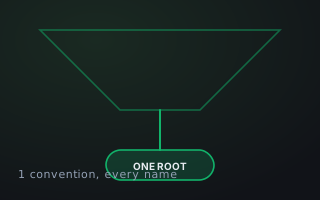

Grounded in

 ISO 24613
Two teams, two names, one broken report.
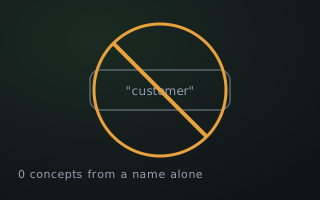
One team calls it customer. Another calls it client. A report tries to join them and quietly drops half the rows. ATGM makes that impossible — every name resolves through one root convention, so the same thing can never wear two different names.
One team calls it customer. Another calls it client.
Every name resolves through one root convention.
The same thing can never wear two different names again.
ATGM is the ROOT of ageni's naming convention. It enforces suffix and name rules that bind word-form types to metaclasses, making it impossible to model a concept from its surface word-form alone — every type resolves through SBVR concepts, facts, roles, and formulations instead.
- 1 The ROOT of ageni's naming convention
- 2 Enforces suffix and name rules binding word-form types to metaclasses
- 3 Impossible to model a concept from its surface word-form alone
- 4 Every type resolves through SBVR concepts, facts, roles, and formulations