AVST · Model
Ageni Value/Virtual Syntax Tree
Catch a broken rule the moment it's written.
Request accessEnforce your conventions on their own.
Parse a page or a model once, then let the grammar itself catch every rule violation — no one has to remember to check.
See it work
Three self-contained views of Ageni Value/Virtual Syntax Tree: how it works, the outcome it moves, and the profit lever it pulls.
What Ageni Value/Virtual Syntax Tree gets you
Every one of these is a real outcome the engine helps a buyer reach — not a feature list.
Enforce your conventions on their own.
↑ reliabilityExtract any page field for almost nothing.
↓ costStop paying an AI to re-read the same page.
↓ costKeep your team's rules from drifting.
↑ reliabilityTurn a model into clean language, natural or code.
↑ speedCatch a rule violation as it's written.
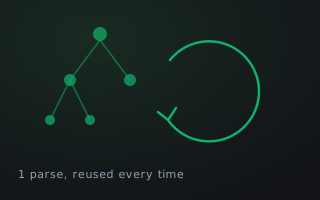
↑ riskReuse one parse across every page of a shape.
↓ timeCut the cost of reading the web at scale.
↓ costKeep formal and natural language in sync.
↑ reliabilityScale extraction without scaling spend.
↓ costEnforce a standard on any single step.
↑ riskShip content that always follows the rules.
↑ reliability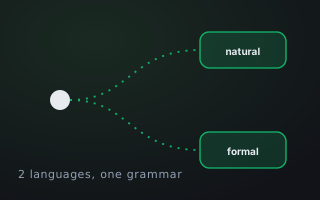

Grounded in
 incremental parser
The rule was written down. Nobody followed it.
A style guide sits in a doc nobody reads twice. A naming rule gets skipped under deadline. AVST extends the grammar itself to enforce the rule on every node it touches, so a violation gets caught the moment it's written — not in a review three weeks later.
A style rule sits in a doc nobody rereads.
The grammar itself enforces the rule on every node.
A violation is caught the moment it's written.
AVST performs Virtual Node Generation — projecting expression into natural and formal languages by extending a language's own grammar to enforce enterprise-specific constraints on any node in the tree. It is built on tree-sitter, the incremental-parsing engine, so one parse is reused across every page or model of the same shape instead of re-read from scratch.
- 1 Virtual Node Generation projects expression into natural and formal languages
- 2 Extends a language's own grammar to enforce enterprise-specific constraints
- 3 Enforces a constraint on any specific node within the tree
- 4 Built on tree-sitter, the incremental-parsing engine